

See What the Eye Can’t: How Thermal Imaging Uncovers Hidden Issues in Buildings
In the world of property inspections, not everything is visible to the naked eye. Behind a freshly painted wall or a clean-looking ceiling, hidden issues like air leaks, moisture buildup, or poor insulation can silently cause damage — until it’s too late. That’s where thermal imaging steps in.
In the world of property inspections, not everything is visible to the naked eye. Behind a freshly painted wall or a clean-looking ceiling, hidden issues like air leaks, moisture buildup, or poor insulation can silently cause damage — until it’s too late. That’s where thermal imaging steps in.
Also known as infrared scanning, this powerful diagnostic tool is rapidly gaining traction among builders, real estate professionals, and facilities managers in Toronto and across Canada. In this post, we’ll explore what thermal imaging is, how it works, and why it’s becoming essential for anyone who owns, builds, or manages property.
What Is Thermal Imaging?
Thermal imaging uses infrared cameras to detect variations in surface temperature. These cameras translate heat into visual images — often called thermograms — that reveal temperature anomalies in walls, floors, ceilings, roofs, electrical systems, and HVAC setups.
Unlike traditional inspections, which rely on visual cues or destructive testing, thermal imaging offers a non-invasive way to quickly pinpoint potential problems.
Why Thermal Imaging Is a Game-Changer for Building Inspections
Thermal scanning provides a level of detail that human vision can’t match. Here are some of the most common — and valuable — applications:
1. Moisture and Water Intrusion Detection
Identify leaks inside walls and ceilings before they cause visible damage
Detect roof leaks, window seal failures, or plumbing issues
Prevent mold growth and material deterioration
2. Insulation & Energy Loss Analysis
Reveal missing or poorly installed insulation
Identify cold spots and thermal bridges
Reduce heating and cooling costs by sealing leaks and improving building envelopes
3. HVAC System Diagnostics
Detect air leaks in ductwork
Identify unbalanced airflow or energy waste
Verify radiant floor heating system performance
4. Electrical System Evaluation
Pinpoint overheating breakers, motors, or wiring
Prevent fire hazards caused by electrical faults
Confirm performance of solar panel arrays or electrical panels
5. Pre-Listing or Pre-Purchase Property Assessments
Help buyers and sellers make informed decisions
Prevent costly surprises during home inspections
Support negotiations with visual, third-party evidence
Who Benefits from Thermal Imaging?
Thermal scanning is no longer limited to industrial use. At Lightbound 3D, we’re seeing demand grow across multiple sectors:
Homeowners looking to improve energy efficiency or detect issues early
Realtors and real estate investors who want to reduce risk in property transactions
Builders and contractors ensuring quality control during construction
Property managers and condo boards monitoring ongoing building performance
Insurance companies and restoration experts assessing damage or claim validity
Why Now? The Case for Thermal Imaging in the GTA
In Toronto’s fast-paced property market, quick, accurate assessments are key. Whether you’re managing a high-rise, renovating a historic property, or trying to sell a home fast — thermal imaging can give you the upper hand.
With tight building codes, rising energy costs, and extreme weather swings, spotting inefficiencies or damage early can save thousands. Infrared inspections give you the clarity and confidence to act — before problems escalate.
What a Thermal Inspection Includes
A standard infrared inspection includes:
A site walkthrough with thermal and visual imaging
Capture of key areas: walls, ceilings, attics, mechanical rooms, roofs, and more
Annotated thermal photos showing temperature anomalies
A detailed PDF report with findings and recommended next steps
At Lightbound 3D, we use high-resolution FLIR thermal cameras to capture both large commercial environments and intricate residential details. We often pair thermal imaging with 3D scanning or Matterport virtual tours for complete property documentation.
Before & After: Real-Life Results
Case Study 1: Air Leaks in a Modern Condo
During a new owner walkthrough, our thermal scan revealed major drafts near the balcony door and along the ceiling bulkheads. The problem? Insulation gaps caused by a rushed install. The builder corrected it before final occupancy — saving the owner from inflated HVAC bills.
Case Study 2: Hidden Moisture in a Leaky Roof
At a 1970s-built commercial property in Etobicoke, a flat roof had been patched several times. Our scan showed pooled moisture within the roofing layers — invisible to the eye. The landlord used our report to request an urgent replacement before winter.
Thermal Imaging vs. Traditional Inspection
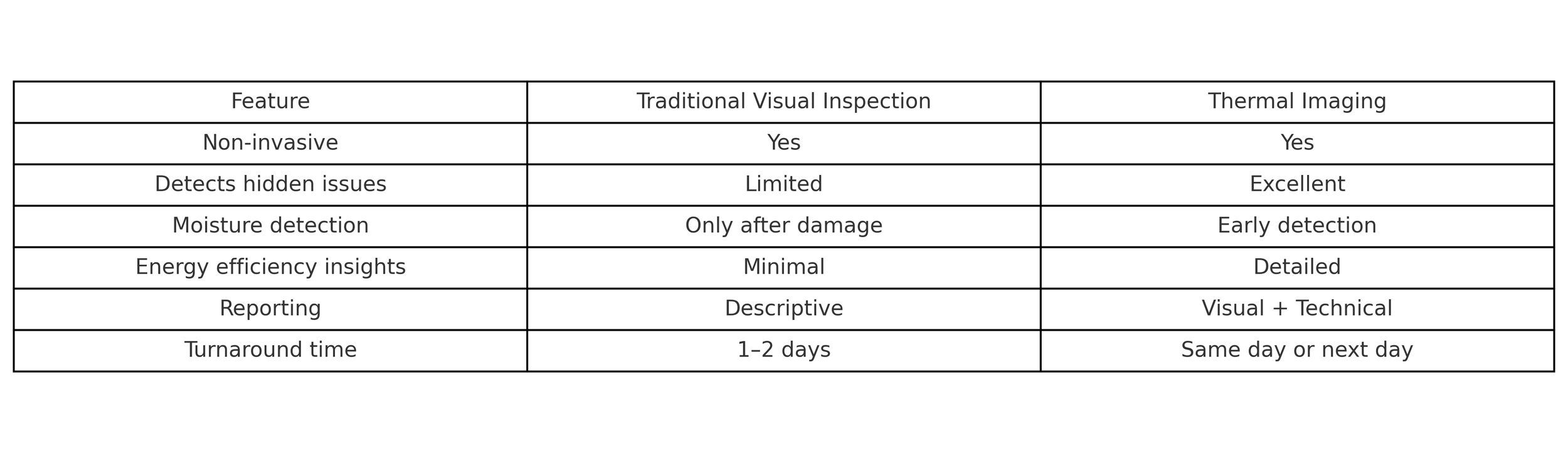
Is It Worth the Cost?
Yes — especially when you consider the potential savings. The average thermal inspection ranges from $300 to $700, depending on building size and scope. But detecting a roof leak early could save $5,000+. Finding missing insulation could cut your energy bill by 10–20% a year.
In the context of real estate transactions, tenant handovers, or renovations, a thermal scan adds peace of mind — and tangible ROI.
Conclusion: Bring Hidden Issues Into the Light
If you’re responsible for a building — as a buyer, seller, manager, or contractor — you need to see more than surface-level details. Thermal imaging is fast, precise, and powerful. It’s not just a nice-to-have — it’s the new standard for smart building diagnostics.
Book a Thermal Imaging Inspection Today
Lightbound 3D offers professional thermal imaging services across the Greater Toronto Area. Whether it’s a full building scan or targeted inspection, we deliver clarity and confidence.
Let us help you uncover what the eye can’t see.

How Does Drone Video Help with Real Estate Marketing?
Few fields have felt the impact of drones as strongly as real estate. But how exactly do drones help people to sell properties? Let’s find out.

Flying drones have seen a huge surge in popularity over the last few years. Hobbyists and professionals alike have been using tools like this to take advantage of the sky, but few fields have felt their impact as strongly as real estate. But how exactly do drones help people to sell properties? Let’s find out.
A New Perspective
Seeing a house from above can give a much better impression of its shape, the land it’s on, and the surrounding points of interest. It can also make a house look larger and more impressive, making this an excellent tool for real estate agents looking to sell more properties. This would have been impossible in the past without a helicopter.
Whole-House Tours
Many of the world’s most popular drones have been designed so that they can be flown indoors. This gives realtors an excellent chance to give people a tour of a property without ever having to visit. This sort of option has never been more crucial than in 2020, with many people unable to go to viewings when they are interested in a new home.
A Professional Look
Companies like DJI have been making huge leaps when it comes to image stabilization in recent years. Many of the world’s drones can hold a camera far stiller than a human can, creating beautiful shots that look like they were made by a professional videographer.
Drones are only going to get more important to realtors in the coming years. While tools like this may seem like toys from the outside, they often offer incredible benefits to the professional world.
Are you interested in learning more about how we use drones to serve our clients? Contact us!
LIGHTBOUND 3D LIMITED
25 Adelaide Street East
Toronto, ON M5C 3A1
email: info@lightbound3d.com
tel: (437) 775-9000

The Benefits of Virtual Staging
Buying a new home is among the biggest and most significant investments for most families. While it is understandable that an owner would want to sell their property fast and efficiently, it is also crucial to give your buyers time to explore what their lives would be once they have settled in.
The property market is always in development, and new trends take over regularly. While some come and go, one aspect has constantly been gaining more importance: customization.
Buyers want to feel at home and imagine themselves in their new living room sipping wine and warming up in front of the fireplace. Even with an effort of imagination, this is not always possible, especially in homes that are still owned by the previous owner or in new properties.
Staging these homes, one of the most successful real estate marketing strategies, is incredibly effective. However, it does not come without a prohibitive bill.
Today, thanks to Lightbound 3D virtual home staging, it is possible to give potential buyers a taste of what their next home will look like - at a minimal cost.
Help Potential Buyers Feel at Home
One of the greatest benefits of real estate staging is that it can change the feel and atmosphere of a room or the whole property. Potential buyers can then feel at home or start imagining themselves in their new property. This is a great advantage and can even set a property apart from any other that the potential buyer has been viewing.
Save Money While Making the Property Look Beautiful
Home staging is one of the best real estate marketing strategies, and it has been seen to improve and speed up the property selling process. However, sellers need to rent furniture and, in some cases, even engage a designer. In turn, this can translate into costly bills that not all sellers are ready to pay.
Virtual staging of homes and properties can be a great solution to provide your clients and potential buyers with this service - at a minimal cost.
Additionally, you can even redesign some features that can increase the property’s curb appeal without great investments.
For example, you can show what the garden would look like with a more enclosing landscape or the view that the top floor’s balcony would have when better redesigned.
Allows for Safe Viewings
Because of Covid-19, most house viewings and selling processes have been affected. While the property market has not been hit as hard as other industries, the pandemic has forced and sped-up some drastic changes in this sector.
One of the major ones involves the way home property viewings are conducted. Indeed, it is no longer safe to spend time indoors with others, and such consequences are bound to last for months to come. Virtual staging is an efficient solution to allow potential buyers to discover the best properties on the market in total safety.
Gives Buyers Time to Explore the Property
Buying a new home is among the biggest and most significant investments for most families. While it is understandable that an owner would want to sell their property fast and efficiently, it is also crucial to give your buyers time to explore what their lives would be once they have settled in.
Virtual staging does just that - it allows them to explore every nook and corner of the property at their own time, allowing them to start planning for their own style and furniture.

Before Virtual Staging

After Virtual Staging

Using Drone Cameras in Real Estate Marketing
Creating a compelling, direct, and exclusive marketing campaign for your properties can be challenging, especially if you are operating on a budget or with limited resources.
Nonetheless, taking beautiful pictures of the properties you are trying to sell is the best way to increase the chances of a sale. Using drone cameras in real estate marketing allows you to take exclusive shots of the properties, highlight beautiful features, and save money. Here's what to expect.
Creating a compelling, direct, and exclusive marketing campaign for your properties can be challenging, especially if you are operating on a budget or with limited resources.
Nonetheless, taking beautiful pictures of the properties you are trying to sell is the best way to increase the chances of a sale. Using drone cameras in real estate marketing allows you to take exclusive shots of the properties, highlight beautiful features, and save money. Here's what to expect.
Benefits of Using Drone Cameras In Real Estate Marketing
It can help you create more dramatic images and compelling videos that will reach potential buyers' eyes and hearts.
It allows you to create more interesting virtual tours to show the property to potential buyers - even in times of Covid-19 and social distancing measures.
It gives you the chance to highlight more property features from a unique point of view.
Drone video and drone photography in real estate marketing offer you the advantage to give potential buyers an idea of the surrounding area and landscape without requiring them to visit the property in person or spend time exploring the surroundings.
Real estate video and photography created through the use of a drone are still relatively new in the industry. Indeed, not many estate agents have invested in this technology yet, which gives you the chance to enjoy a unique selling point and advantage over the competition.
Aerial pictures are undoubtedly a way to interest potential buyers, making the property look fantastic and show beautiful imagery. Nonetheless, taking photos from a helicopter can be extremely costly and difficult to arrange. Drone photography is the obvious choice to get the best of both worlds!

Selling A Property in the Times of COVID-19: Here Is What's Changed
The pandemic - and ensuing social distancing measures - has influenced many aspects of our daily lives, and it has not spared the way we sell our properties and find the dream family home.
The pandemic - and ensuing social distancing measures - has influenced many aspects of our daily lives, and it has not spared the way we sell our properties and find the dream family home. Luckily, on this, cutting-edge technologies such as Matterport photography and 3D virtual tours are on our side.
Indeed, visiting houses during this unusual time can be unsafe and challenging. Of course, staying within closed spaces with other people is not recommendable. But, so, how can you show the wonders of a property to potential buyers?
Matterport photography, a three-dimensional camera system that allows creators to bring to life fully-immersive, incredibly realistic experiences and virtual tours, gives you the chance to explore every nook and corner of a property together with a potential buyer.
The high-quality imagery and accurate measurements collected by these systems can also give the real feel of a property's space, style, and character.
The advantages of using virtual staging to explore a property include the fact that this system allows you to picture potential buyers in it, presenting it as a white canvas to start designing an ideal space.
Ultimately, a high-resolution virtual tour allows potential buyers to take their own time to understand if that property is right for them truly. When these virtual tours are hosted by the owner or knowledgeable estate agent, buyers will feel like they have all the support needed throughout such a crucial process. Such high-end technology can enhance the property-viewing process, giving a chance to buyers to keep exploring options and selecting the home of their dreams - all in complete safety!

Housing Market, COVID-19 and 3D Virtual Tours
When COVID hit it changed everything. All of a sudden families were stranded at home and there was a renewed focus on nesting, akin to what we saw immediately after 9-11.

We’ve seen a dramatic change in our business since the pandemic ground everything to a halt in March. Yes, the economy is coming back slowly, there is definitely activity but it’s different. We’ve always marketed our platform as convenience - why just take photos and videos when you can have the whole space on in immersive 3D on your device, showcase it to prospects and walk-thorough anytime you want! Who would not want that?
When COVID hit it changed everything. All of a sudden families were stranded at home and there was a renewed focus on nesting, akin to what we saw immediately after 9-11. What does “home” mean - the answer is different depending who you ask, it’s a space for work, as space for leisure, a shelter and a gathering place for the family. Perhaps they were thinking of moving someday, get a second home or just improving the one they have. Well that moment arrived overnight - it is here now.
While the economy may be in a recession mode from the pandemic with forced shutdowns, the real estate market remains strong, thanks in part to good mortgage rates and the desire of many people in the city to relocate. Knowing they can work from anywhere, why not also love where you live. Technology has played a major role!
How Matterport Virtual Tours changed Real Estate
We scan you space in 3D to create virtual tours. These are immersive, meaning you can experience the space from the first person, akin to a video game. We’ve developed a streamlined process that help realtors get exposure for their listings 24/7, in a physically distant and safe manner. With Matterport, you will be able to engage prospects and carry on business quickly and efficiently from any location, regardless of timezone.
In a survey conducted last month and published Aug. 5, Redfin said that 25% of respondents indicated that the pandemic has made them want to move or has sped up their plans to relocate.

Source: Redfin
Take your real estate marketing to new heights. Learn how we can help getting your home sold quickly with a Matterport 3D Virtual Tour of your home. We use only Matterport 3D and the most advanced cameras to capture the essence of a space for exquisite tours.

We are open for business during COVID-19, but things will be different!

We are encountering a higher demand for our services, helping organizations stay open virtually and augmenting real estate listings with immersive 3D Matterport tours.
In order to keep everyone safe the following protocols are followed, no exceptions:
Properties must be vacant and prepared to be imaged. In case of commercial properties, only required essential staff should be present.
We will address your project requirements prior to appointment. Under no circumstances shall anyone other than us or essential staff be present at location.
If you suspect you have been in contact with Covid-19 or don’t feel well, please take care of yourself, be responsible and let us know! We are in this together and we offer you the same courtesy.
We follow strict safety precautions as recommended by health authorities. This means we move slower, wear protective gear and sanitize our equipment between appointments.
Now more than ever it matters what we do. We can beat this thing but only if we work together and practice social distancing. Stay well!

Walk through a space as if you were really there with Matterport VR
Experience a space from anywhere with Matterport VR. Built-in to every tour we make!

Experience a space from anywhere with Matterport VR. Built-in to every tour we make!

Advocating for a more fair and efficient real estate industry
The typical commission paid to agents of both buyers and sellers averages at 2.5%, typically totalling 5% of the home's selling price, and adding thousands of dollars to the cost for both parties. Justo has changed all that.

Justo Using Disruptive Technology to Shake Up Real Estate Biz
In the increasingly pricey Greater Toronto Area housing market, every dollar counts for both the buyer and the seller. With land values and speculation driving home prices ever higher, brokerage commission fees are often overlooked as a factor in how much a purchaser pays or a seller receives for their home. The typical commission paid to agents of both buyers and sellers averages at 2.5%, typically totalling 5% of the home's selling price, and adding thousands of dollars to the cost for both parties.
Read full article at Urban Toronto

Are you ready to buy a home?
Answer these questions to learn if you're ready to make the biggest purchase of your life!

Take this Real Estate Quiz by Justo brokerage to learn if you’re ready to make the biggest purchase decision in your life!

Virtual Tours get clicked 40% more than listings with no tours!
Virtual Tours get clicked 40% more than listings with no tours!
The reason for these successes is that 3D virtual tours engage buyers in a way words and photos can not. They offer ‘location intelligence’ and a visceral sense of a property that increases emotional engagement. And unlike an open house or home visit, with a 3D virtual home tour, the prospect can take their time – from wherever they may be located – to delve into any feature that would make a house or apartment feel like a home.
Virtual tours get clicked on 40% more than listings without virtual tours
Properties featured with virtual tours get 95% more phone inquiries
Properties featured with virtual tours receive 65% more email inquiries versus those without
Virtual tours generate 49% more qualified leads
All eyes are on the internet today, if you don’t capture your audience right away, it’s an opportunity lost!

Toronto startups look to disrupt Canada’s real estate model!

From the Globe & Mail November 12, 2018 | By: SHANE DINGMAN, REAL ESTATE REPORTER
Two Toronto-area startups are betting that a combination of technology, regulatory changes and consumer behaviour have created the conditions necessary to finally bring about a transformation of the country’s traditional real estate model.
Regan McGee, chief executive of startup Nobul (which he describes as a marketplace platform where potential buyers and sellers get bids for service from realtors), says that, in recent years, accumulation of anti-trust and competition regulations in the United States and Canada have pushed the industry to a tipping point. “They created an environment where a company like us could exist. [Before now] it would have been really hard. This is the way everything is going,” he said.
“The industry is changing, and I could feel the change coming,” says Vicki Schmidt, co-founder and broker of record for Justo, a new twist on the online discount brokerage.
These two companies are just a few of the real estate-focused startups popping up or expanding across the country, but they have one thing in common: The market opportunity they sense is to put more negotiating power, and perhaps more cash, in the hands of the real estate buyers and sellers. That could also put pressure on the traditional commission structure and service offering from agents.
Justo’s idea is mainly a tech-enabled update on an old idea: the discount brokerage. Founded by Daphne De Groot, an Israeli immigrant on a startup visa (who has dabbled in real estate developing, reality television and marine biology in an interesting career path) who partnered with Ms. Schmidt to try to build something more like the real estate model in her home country.
“In Israel, when you go buy a house, you have something like Kijiji. You go on the site, you pick a house you like, you just buy it directly … you don’t do it with an agent, just a lawyer and that’s it,” Ms. De Groot said. “When I tried to do it here myself, I had no access to any of the data: who bought the house, when, comparables.”
With an outsiders eye, she dissected the traditional real estate model in Canada and realized two things: Agents were necessary here, for many reasons, and enough of the data were getting to the public that some of the functions of agents could be shared between buyer and agent. Justo is designed to keep the agent involved, while operating a VOW-type website that helps buyers and sellers see what’s happening in the market, and wrap it all up into a couple of lower fee options.
Justo’s fee model is calibrated for the expensive side of the GTA: If your home purchase is for more than $600,000 (which is about $150,000 lower than the region’s average detached-home selling price), you pay a flat $15,000 in commission. Additionally, while Justo will still split the full traditional 5-per-cent commission with listing agents, it will give buyer clients a chunk of the difference between the $15,000 and the 2.5-per-cent share as a cash-back bonus (the estimated cash-back is posted on all the Justo site’s online listings). “Its a reduction on your house, ‘Money out of the sky,’” Ms. De Groot said. If what you buy is less than $600,000 there’s no cashback and no flat fee, just the usual 2.5-per-cent fee.
For sellers, the structure is a simple reduced fee: 1.5-per-cent commission for 90 days at a guaranteed price, and if they don’t sell in that time, they will reduce the commission to 1 per cent.
Ms. Schmidt says the structure is similar to a friends-and-family deal, adding that what attracted her to Ms. De Groot’s vision was, “The idea of partnering with [clients] and sharing a bit of that commission with them, because they are a big part of that partnership.”
Mr. McGee’s startup, Nobul, comes at the industry with a similar ethos – that the client wants more service than what they get today – but his vision is built on an real estate insider’s view (he’s a former commercial realtor and still has his licence) of an industry that has managed to avoid fundamental change despite the existence of gigantic U.S. property tech companies such as Zillow and Redfin.
“Real estate is super entrenched in doing things the way it’s been done forever,” he said, arguing that no internet company has done to real estate what Uber and Airbnb have done to transportation or hospitality.
The concept is deceptively simple: Buyers or sellers come to Nobul to find an agent and agents on the platform offer a bid for that client, either a straight-up break on the commission or through expanded service offerings. Additionally, a combination of user ratings and reviews will help clients compare bidding agents (someday soon, Nobul also hopes to include agent performance metrics, such as list-price-to-sale ratios, in order to find who truly are the best negotiators).
Unlike traditional online brokerages, agents you find on Nobul don’t work for the startup (350 agents have been actively using the platform since its soft launch in April), they just use the site as a matchmaker to pitch their services.
“Most of the job of being a real estate agent is customer acquisition,” Mr. McGee said. “We’re seeing right now about three-to-one buyers to sellers [browsing on the platform] and a tonne of first-time buyers. Most of the people coming to our platform are millennials … they don’t have a relationship with some real estate agent who got their licence back in the seventies.” Right now, if a buyer is scrolling through Realtor.ca, there’s no easy way to find an agent to help you buy a dream house you spotted. There’s no reasons those buyers wouldn’t like to begin and end their property search online, Mr. McGee says: “This is the way that the whole world is going.”
Of course, open bidding does mean that Nobul could have the affect of compressing commission fees, which agents are often reluctant to do. “Sure, it’s inevitable,” he agrees, but points out that fee compression won’t hurt Nobul’s bottom line. “We make our money not on the commission, but on the property value. We get 20 basis points on the property value … which is $2,000 per million of property value. Fee compression over time will have zero impact on our revenue.”
Further, he says regulators Nobul has spoken with when negotiating entering new markets approve of the company’s goals. “Regulators are trying to achieve transparency, price competition, get rid of price fixing, they wanted the public to be happy with the biggest fees they pay in their lives. Everybody else talks about how it’s the biggest purchase in your life, they often forget to mention it’s the biggest fee you’ll ever pay, too.”
Nobul will need scale in order to work, which is why it is already expanding across Canada and into the United States. To help with that, it has attracted an enviable collection of investors in its multimillion-dollar seed fundraising, including some big-time real estate developers (a notoriously risk-averse group).
“People are looking to what makes life easy for them, where do they get a benefit? Clients want the cheapest quality brokers, this allows a buyer or seller to reach out to hundreds or thousands of brokers,” says Sheldon Fenton, CEO of Reserve Capital, which with Reserve Properties has built more than 12,000 housing units over the past 30 years. Mr. Fenton said that in addition to knowing Mr. McGee and his family, he liked the investing team and management (the board includes Canadian business notable Blake Goldring). “Developers are typically conservative. I invest in a limited number of tech opportunities that are not necessarily real estate driven. This is one we took a shine to – this is a small investment for us – but I put my money up and I believe in their concept.”

Lightbound 3D Welcomes Justo Real Estate as an Alliance Partner
Justo is Toronto’s newest concept in real estate, offering comprehensive marketing and real estate services at no extra charge! Professional photography, 3D virtual immersive tours, staging, lawyer and brokerage fees are all included.

Lightbound 3D is pleased to announce it has partnered with boutique firm Justo Real Estate in Toronto. Justo is an alternative option for buyers and sellers who are frustrated by elite brokerage commissions. Justo is Toronto’s newest concept in real estate, offering comprehensive marketing and real estate services at no extra charge! Professional photography, 3D virtual immersive tours, staging, lawyer and brokerage fees are all included. Justo is data driven and uses the power of technology and efficiently to lower costs, passing on savings to our customers.


Piece of Mind
We are so confident you will be impressed, our Immersive 3D Tour will be offered FREE if your home fails to sell.

Matterport is the only tool that’s going to sell your home in today’s competitive market.
We are so confident you will be impressed, our Immersive 3D Tour will be offered FREE if your home fails to sell. What do you say?
Book your Immersive 3D Tour package now or call us at 437-775-9000 We will answer all your questions!

Your SEO Checklist for 2018
It's the start of a new year and it's time to review your SEO priorities. Looking back over the years, we see various changes that Google make that SEO managers must follow, or face certain death.

It's the start of a new year and it's time to review your SEO priorities. Looking back over the years, we see various changes that Google make that SEO managers must follow, or face certain death. There was the Panda updates and then Penguin from Google. These updates have often sent SEO mangers into a frenzy of ‘what ifs’, ‘hows’ and ‘whens’ and indicate the constant evolution taking place. SEO is a process, not an event, and as such managers must constantly review, assess and redefine the priorities for SEO.
1. STRUCTURED DATA
Structured data markup is the technology behind the semantic web and Google’s rich search results. The semantic web is an improved web which delivers more relevant search results to users and more qualified traffic to websites. Structured data is a way of enriching content on a web page that makes it more machine-readable by linking entities together. Vocabularies like Schema.org (vocabularies are the structures you add to your data) allows search engines to create those fabulous rich snippets that contain data like star reviews, opening hours and prices. Not only do they make your search result more eye-catching, they also improve click-through-rate (CTR). Despite numerous studies showing pages that use Schema markup ranked four times higher in SERPs (Search Engine Results Pages), the adoption of structured data has remained slow, which means that sites that use structured data will ultimately perform better in 2018.
2. SECURE YOUR SITE WITH HTTPS
In 2014 Google announced that sites that were SSL secure were going to be given a slight boost to rankings. Adoption was relatively slow to begin with because many believed that it would only really impact E-Commerce sites. It is estimated that around 50% of sites that appear on page 1 of Google are SSL secure sites (including non-ecommerce sites), and is predicted to be around 65% by the time 2018 rolls around.If your website still isn’t secure by now, you’re basically leaving rankings on the table. Not to mention leaving your site vulnerable to spam and mock sites with your content, that is just plain annoying.
3. TARGET INTENT MESSAGING
Search intent is what the person using a search engine hopes to achieve through their search. People generally have four (depending on how you want to count them) when the use Google:
- Geographic search: Users want to go somewhere, but don’t know where it is or how to get there. The "place" they want to go could be an actual physical location like a store or it could be a specific page on a website.
- Informational search: Users want to answer a specific question, solve a problem or just find general information on a topic. These people make up the majority of search engine users at any given moment.
- Transactional search: Users want to take a particular action. In the marketing world, this is often called "commercial intent", looking for an actionable outcome, like buying a product or servie on
Optimizing your website content to match your audience’s search intent was vital to SEO in 2017, and it’s only going to get more important for SEO in 2018.
4. SLOW LOADING WEBSITE PAGES
The biggest reason for page abandonment is slow loading websites. If you're found via a web search and your page does not load, user moves on period. They rarely if ever come back. Google also queries your site for speed, and now also evaluates site speed as part of its ranking criteria. Here are some of the biggest culprits that bog down websites:
- Unnecessary plugins, tracking codes, advertisements and on-page widgets. These are especially bad if any of them block your main page content from loading. Load any news site and you see what I mean, annoying!
- Bloated image resources. This has been my pet peeve since the adoption of digital cameras! Optimizing for the web is mandatory. Using HTML to change the dimensions of images is a common mistake. This doesn’t impact file size and therefore doesn’t improve speed. Instead, use your photo editing software’s compression to optimize images for the web. Many programs have "save for web" options when exporting.
- Uncached assets: Caching tells browsers to store files to load for the next visit. This means users don’t have to wait for an image or stylesheet to download every time the visit a page. This can vastly reduce wait time for repeat visitors. Check out Google’s guide to leveraging browser caching.
- Uncompressed assets: All modern browsers support gzip compression, which is a method of zipping files to reduce their size by up to 90 percent. Gzip compression needs to be enabled on your web server. Google’s got a great set of resources on how to do this.
Our mission is to continue to provide you with the SEO information you need to promote your brand online. Know what high value keywords your customers use to find your products and services. Be found on the web, and appear on the first page of Google and Bing SERP's (search engine results pages). Please contact us at info@lightbound3d.com or call (437) 775-9000 for a free, no obligation consultation.